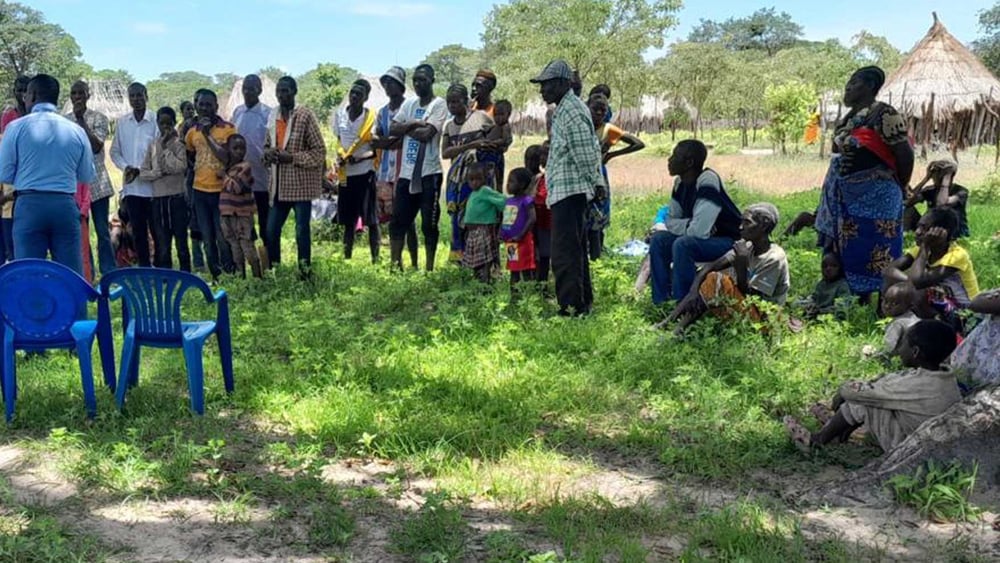
Rassemblement de la communauté Vikolôngwa-Mbútwa dans la province de Huíla, en Angola
Rassemblement de la communauté Vikolôngwa-Mbútwa dans la province de Huíla, en Angola © ACC_Domingos Fingo
Ouvert
Urgent Action − Angola

Les poursuites visant sept membres d’une communauté doivent être abandonnées

Le 23 novembre 2024, sept membres de la communauté Vikolôngwa Mbútwa, dans la province de Huíla, en Angola, ont été arrêtés et placés en détention après une violente intervention de police en relation avec un conflit foncier. Ils ont tous été remis en liberté depuis lors - deux d’entre eux au bout de 13 mois - mais sont actuellement jugés pour diverses infractions. Leur procès s’est ouvert en décembre 2025, et la date de l’audience de prononcé du jugement doit être fixée d’un jour à l’autre. Les autorités angolaises doivent immédiatement abandonner les charges qui ne sont pas étayées par des éléments de preuve crédibles et obtenus légalement, et lancer une enquête efficace et impartiale sur les allégations de torture, de mauvais traitements et de recours excessif à la force formulées par ces sept personnes.

Passer à l'action

Défendez les droits de la communauté Vikolôngwa Mbútwakorrekt: envoyez une lettre d'appel par postee-mail et Tweetez/postez dans les réseaux sociaux via X/Twitter ou Facebook.

Agir jusqu'au 14 septembre 2026

Modèles de lettre

Adresses

Procureur Général de la République :
Prosecutor General of the Republic
Pedro Mendes de Carvalho
Rua 17 de Setembro
Cidade Alta
Luanda
Angola
E-mail: procuradoriageraldarepublica@pgr.ao

Copies à

Ministry of Justice and Human Rights 
Minister: Marcy Cláudio Lopes  
E-mail: geral@minjusdh.gov.ao   

Ministry of Territorial Administration 
Minister: Daniel Félix Neto  
E-mail: geral@mat.gov.ao  

Ministry of Agriculture and Forestry 
Minister: Isaac Francisco Maria dos Anjos  
E-mail: gticii@minagrif.gov.ao    

President of Angola, Mr. João Lourenço  
c/c the Secretary-General of the President, Ms. Sónia Veigas  
Secretário-Geral do Presidente da República  
Órgãos Auxiliares do Presidente da República  
Palácio Presidencial, Rua 17 de Setembro  
Cidade Alta – Luanda, Angola  
E-mail: secretariageral@oapr.gov.ao 

Botschaft der Republik Angola
Thunstrasse 73
3006 Bern
Fax: 031 351 85 86
E-Mail: embaixada.suicaberna@mirex.gov.ao

Agir sur les réseaux sociaux

Possibility to message and tag:

Public Prosecutor
on X/Twitter: @PgrAngola  

Ministry of Justice and Human Rights
on Facebook: MINJUSDH / @Minjusd  

President of Angola
on X/Twitter: @jlprdeangola 

Hashtags:
#Angola #JusticeForVikolongwaMbutwa #StopPoliceViolence #FairTrialRights #LandRights 

Suggested Tweets: 

1/3 
#Angola: On 23 November 2024, seven members of the Vikolôngwa Mbútwa community in Huíla Province, Angola, were detained after a violent police intervention during a land dispute. Two pregnant women were aggressively handcuffed, and one man was reportedly beaten unconscious. #JusticeForVikolongwaMbutwa  

2/3 
Although five were later released on 25 November 2024, all seven remain charged with various offences, and two of the men spent nearly 13 months in pretrial detention before being released on 16 December 2025. A new date for the reading of the judgment may be set at any time. Authorities must ensure full respect for fair trial rights. #FairTrialRights #Angola  

3/3 
Angolan authorities must drop any charges not supported by credible and lawfully obtained evidence and promptly investigate the allegations of torture, ill-treatment and unnecessary and excessive use of force against the seven community members.. #StopPoliceViolence #LandRights [Link to UA]  

-

The case of the Vikolôngwa Mbútwa community is not happening in isolation. Amnesty International has already documented how the diversion of communal grazing land to commercial farmers in southern Angola has harmed pastoralist communities and deepened vulnerability and food insecurity. #LandRights #JusticeForVikolongwaMbutwa Report link

Plus d'info

Vikolôngwa Mbútwa est une communauté rurale proche de Chibia, dans la province de Huíla (sud de l’Angola), dont les membres dépendent de l’agriculture et de l’élevage pour assurer leur subsistance. Cette communauté considère les terres faisant l’objet du litige comme son territoire ancestral, et estime que le conflit a débuté lorsqu’un propriétaire terrien local a commencé à procéder à des excavations dans la zone. Un fossé d’environ trois mètres de large et de profondeur a notamment été creusé autour de la zone concernée, représentant un risque de sécurité pour les résident·e·s et les animaux, et restreignant l’accès à des pâturages et à des terres fertiles utilisées pour les cultures. Des membres de la communauté affirment qu’ils ne peuvent depuis lors plus faire paître leurs animaux, ni accéder à des terres qu’ils avaient précédemment cultivées, ce qui les oblige à se limiter à cultiver uniquement les zones entourant leurs domiciles. Le 14 août 2024, trois mois avant les arrestations, la communauté avait demandé l’intervention de l’administrateur municipal de Chibia. Elle a fait appel au gouverneur de Huíla le 23 septembre 2024, et attendait encore une réponse officielle lorsque la police est intervenue le 23 novembre 2024.

Le 25 février 2025, les procédures spéciales des Nations unies ont écrit au gouvernement angolais à propos de l’affaire, faisant état de leurs préoccupations face aux violences, aux arrestations arbitraires et au traitement infligés aux membres de la communauté. Sapalo António Kakandi aurait été atteint à l’abdomen par une balle en caoutchouc, Paulo Cambuta Kapaya a été frappé au front avec la crosse d’un pistolet, et Eduardo Mbambi Licino Kessongo a été roué de coups en garde à vue jusqu’à ce qu'il perde connaissance, et a été privé de vêtements pendant une semaine. Francisca Tuahuma et Cecília Candumbo Mweyanavi, toutes deux enceintes à l’époque, auraient été soumises à des traitements dégradants au poste de police de Quihita, où elles se trouvaient en garde à vue. Plus d’un an après leur arrestation, ces sept personnes n’ont toujours pas reçu de soins médicaux et continuent à connaître des souffrances persistantes. Francisca Tuhaumaa déclaré que son bébé est né avec des problèmes de santé après les violences qu’elle a subies.

Cette affaire rappelle des questions plus larges déjà abordées par Amnesty International en 2021 dans son rapport intitulé The End Of Cattle's Paradise. L’organisation a découvert que dans les provinces de Huíla et Cunene, la vulnérabilité des communautés a été accrue par le détournement de pâturages communaux vers des exploitants agricoles commerciaux, et qu’à Gambos, dans la province de Huíla, l’occupation de terres parmi les plus fertiles par des exploitations agricoles commerciales a compromis la résilience économique et sociale de communautés pastorales et aggravé l’insécurité alimentaire. Amnesty International a également signalé que le détournement de pâturages traditionnels pour l’agriculture commerciale a mis à mal les moyens de subsistance de populations rurales déjà affectées par la sécheresse.

En détail

Numéro UA:
Date de parution | Actualisé le:
Index:
UA 030/26
14.04.2026
AFR 12/0891/2026
Participation prévue jusqu'au: 14 septembre 2026
Action urgente complète (Word): français
english
Modèle de lettre uniquement (Word): français
english

Étant donné que les situations peuvent changer, veuillez vérifier avant d'envoyer votre lettre si la campagne de lettres est toujours active.

English version

Drop charges against seven community members

On 23 November 2024, seven members of the Vikolôngwa Mbútwa community in Huíla Province, Angola, were arrested and detained following a violent police intervention during a land dispute. Although they have all since been released – albeit two of them after 13 months - they are currently on trial on various charges. Their trial began in December 2025, with the hearing on the final verdict due to be set at any time. Angolan authorities must immediately drop the charges not supported by credible and lawfully obtained evidence and launch an effective and impartial investigation into the seven’s allegations of torture, ill treatment and excessive use of force.

Vikolôngwa Mbútwa is a rural community near Chibia, in Huíla Province, southern Angola, whose members depend on farming and livestock rearing for their livelihood. The community considers the disputed land to be ancestral community land and that the conflict started when a local landowner began excavation work around the area. This excavation involved a ditch approximately three meters wide and deep around the disputed land, creating safety risks for residents and animals and restricting access to grazing land and fertile fields used for cultivation. Community members report that they have since been un-able to graze their animals or access land they previously farmed, forcing them to cultivate only in the yards around their homes. On 14 August 2024, three months before their arrests, the community had requested the intervention of the Municipal Administrator of Chibia. On 23 September 2024, they ap-pealed to the Governor of Huíla and were still awaiting an official response when the police intervened on 23 November 2024.

On 25 February 2025, UN Special Procedures wrote to the Government of Angola regarding the case, raising concerns about the alleged violence, arbitrary detention and treatment of the community members. Sapalo António Kakandi was reportedly struck in the abdomen by a rubber bullet, Paulo Cambuta Kapaya was hit on the forehead with the butt of a gun, and Eduardo Mbambi Licino Kessongo was beaten in custody until he lost consciousness and had no clothes for a week. Francisca Tuahuma and Cecília Candumbo Mweyanavi, both pregnant at the time, were reportedly subjected to degrading treatment at the Quihita police post where they were in custody. Nearly Over a year after their arrests and the seven community members have still not received medical care and continue to complain of persistent pain. Francisca Tuhauma reported that her baby was born ill after the violence she suffered while pregnant.

This case echoes wider concerns already documented by Amnesty International in 2021 in its «The End Of Cattle's Paradise» report, where it found that in Huíla and Cunene provinces, communities’ vulnerability has been intensified by the diversion of communal grazing land to commercial farmers, and that in Gambos, Huíla Province, the occupation of more fertile land by commercial farmers has undermined the economic and social resilience of pastoralist communities and worsened food insecurity. Amnesty International has also warned that the diversion of communal grazing land for commercial farming has eroded the livelihoods of rural communities already affected by drought.

_
Please take action before 14 September 2026.

You'll find all necessary adddress- and social media information above. English model letter as a word-file.